Fracture gradient methods
Hubbert and Willis
According to Hubbert & Willis, the theoretical basis of formation fracturing is that the total stress is equal to the sum of the formation pressure and the effective stress. Based on a theoretical and experimental examination of the hydraulic fracturing mechanics, the authors argue that in-situ stress is characterized by three unequal principal stresses and that hydraulic pump pressure must be approximately equal to the least of these main compressive stresses.1

where
P is the pore pressure.
S is the overburden gradient.
Matthews and Kelly
This method introduces the effective stress coefficient variable into the formula:

where

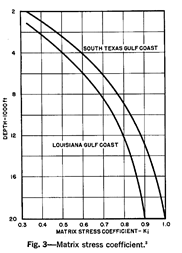
Ki behavior with depth click to enlarge
In the equation for Ki, sH is the horizontal effective stress, and sV = S – P.
Values of Ki are based on fracture threshold values derived empirically in the field. The effective stress coefficient Ki is variable and depends on depth.
Eaton
Eaton, stating that rock deformation is elastic, replaces Ki in the above method by a value calculated from Poisson’s ratio.
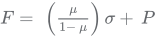
This method requires regional curves of Poisson’s ratio to be established, and is therefore subject to the same restrictions as the Matthews & Kelly’s method.
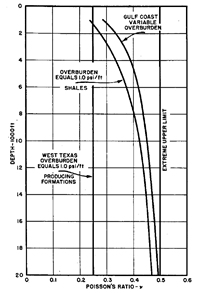
Variation of Poisson's ratio with depth click to enlarge
Daines
Although the Daines method is not used in JewelSuite Geomechanics, you can add it as a user defined equation (see Setting rock dependent constants).
Daines, building on the work of Eaton, introduced a superimposed tectonic stress correction:

where
 = superimposed tectonic stress
The value of  can be evaluated from the first leak off test. It is considered constant for the rest of the well.

where 0.052 is unitless.